


Theme:
What closure mechanisms are required for military packaging in the field?
From MIL-SPEC to STANAG: discover which closure mechanisms make military packaging field-ready.
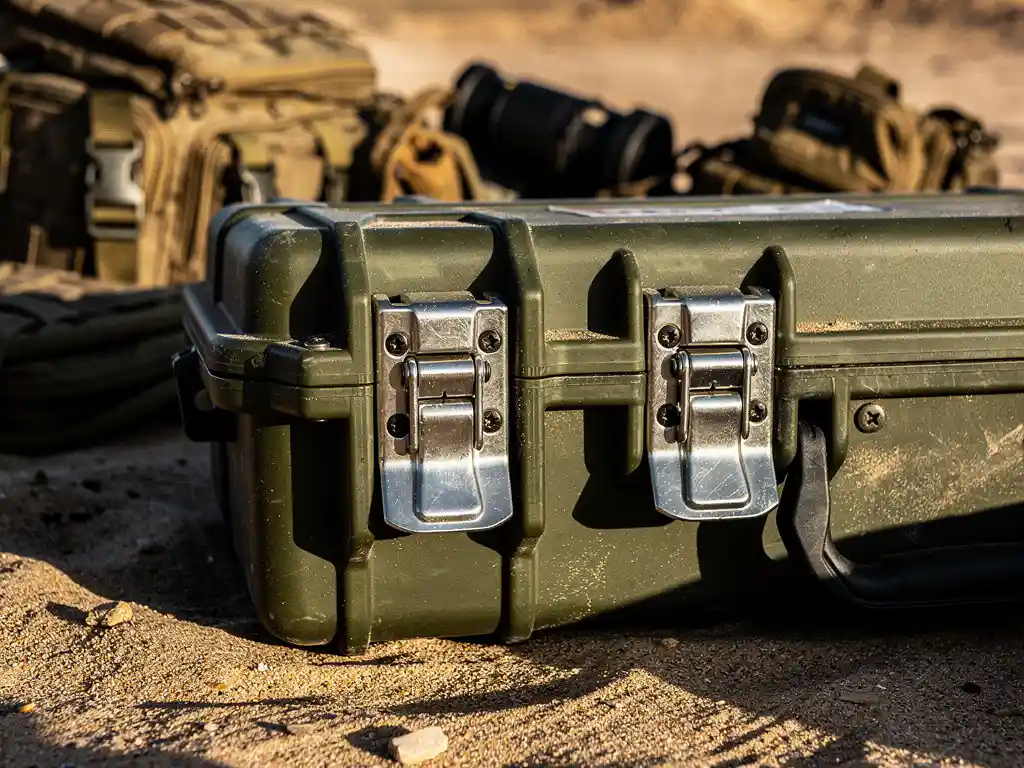
From MIL-SPEC to STANAG: discover which closure mechanisms make military packaging field-ready.
Military field packaging requires closure mechanisms with multiple locking points, resistance to vibration and extreme temperatures, and tamper-evidence features. These include butterfly latches, stainless steel locking pins, and pressure relief valves combined with primary closures. The exact requirements depend on the applicable MIL-SPEC standard, the type of equipment, and the operational environment. This article answers the most frequently asked questions about closures for military packaging, from standard requirements to testing methods.
The primary MIL-SPEC standards that set closure requirements for military packaging are MIL-STD-648, MIL-PRF-117, and MIL-STD-2073. These standards specify the mechanical, environmental, and functional requirements a closure must meet before equipment is considered safe for military transport.
MIL-STD-2073 is the overarching standard for military packaging procedures and defines the protection levels (Level A, B, and C) that directly influence closure selection. Level A requires the highest level of protection, including hermetically sealed or watertight closures with pressure equalization. Level C permits lighter protection for less sensitive goods.
In addition to American MIL-SPEC standards, STANAG standards (NATO Standardization Agreements) are also relevant for European and Dutch defense organizations. STANAG 4280 and related documents set requirements for the transport durability of packaging, including its closure systems. Anyone supplying NATO partners must demonstrably comply with these standards.
It is important to note that the standard does not prescribe the closure itself, but rather the performance requirements. A manufacturer or packaging specialist must then demonstrate that the chosen closure meets those performance requirements through validated test protocols.
The most commonly used closure types in military packaging are butterfly latches, stainless steel locking pins, pressure relief valves, padlocks, and combination locks. Each type has a specific application depending on the required protection level and operational context.
The choice between these types is never arbitrary. Operational requirements, the weight of the case, the frequency of opening, and the risk profile of the contents together determine which closure system is most appropriate.
Extreme conditions such as temperature fluctuations, high humidity, sand, salt, and mechanical shock place high demands on closure mechanisms. A closure that functions perfectly in a climate-controlled warehouse can fail in the field due to material expansion, corrosion, or blockage by debris.
Metal closures expand in heat and contract in cold. In environments with large temperature variations — such as desert operations with hot days and cold nights — this can lead to gradual deformation, causing a closure to no longer seal properly or to become stuck. Stainless steel and anodized aluminum are the preferred material combinations due to their stable coefficients of thermal expansion.
Maritime environments and tropical climates dramatically accelerate corrosion. Closures for these conditions must be fitted with corrosion-resistant coatings or be made entirely from materials that withstand salt spray. MIL-STD-810 includes specific test procedures for salt spray resistance that provide insight into the service life of closures under these conditions.
Sand and dust present a separate challenge: fine particles can block or wear down mechanical closures. Closures with enclosed mechanisms and minimal external moving parts perform better in this regard than open-construction designs.
A single closure system uses one mechanism to keep the case closed, while a multiple closure system combines two or more independent closures for added security, better load distribution, or greater tamper resistance. For military packaging, a multiple closure system is the standard for mission-critical equipment.
The advantage of multiple closures goes beyond simple redundancy. On larger cases, multiple locking points ensure an even distribution of closing force across the entire perimeter of the lid. This prevents the lid from coming loose at a single point during shock or pressure changes while the rest remains closed — a situation that would compromise the seal.
Multiple systems also combine functions: a primary butterfly latch for quick access, combined with a locking pin for additional security and a tamper-evident seal that makes it visible whether the case has been opened. Each element serves its own role within the overall system.
Single closures are acceptable for low-risk ancillary equipment or for the outer transport packaging when the contents are already housed in a protected inner package. The choice always depends on the protection level required by the standard or the client.
A certified UN closure is mandatory when the packaging contains hazardous materials subject to ADR, IATA, or IMDG regulations, such as ammunition, explosives, or chemical agents. A MIL-STAN certified closure is required when the client or contract explicitly references a specific MIL-SPEC standard, or when the packaging is intended for military use under NATO standards.
In practice, both certification requirements frequently apply to the same packaging. A case for transporting ammunition must comply with UN requirements for hazardous materials as well as the military specifications of the end user. This means the closure must have passed both testing regimes and that the associated documentation must be available.
For defense organizations procuring military packaging, it is essential to clearly specify which standards apply in the procurement documentation. Missing or incorrect certification can lead to rejection during inspection or, worse, to packaging failure in the field.
Civilian applications in the security sector — such as equipment for police or fire services — generally do not fall under MIL-STAN, but may be subject to specific NEN standards that impose comparable requirements on closures and sealing.
A closure mechanism is tested for military suitability using standardized test protocols from MIL-STD-810 and related standards. These tests simulate the conditions a package encounters in practice: vibration, shock, free fall, temperature extremes, moisture, and pressure changes.
The most relevant tests for closures are:
After each test, the closure is inspected visually and functionally. Deformation, corrosion, loss of closing force, or damage to the seal are grounds for rejection. The test results are recorded in a qualification file that accompanies the product and must be available for submission to defense clients upon delivery.
Faes develops and manufactures complete military packaging solutions in which the selection of the closure system is an integral part of the engineering process. No off-the-shelf solutions — only custom work tailored to your specific operational requirements, the applicable standards, and the equipment that needs to be protected.
What Faes specifically offers defense clients:
With more than 35 years of experience in custom industrial packaging and specific expertise in the defense sector, Faes understands what is at stake when equipment must perform in the field. Want to know which closure system best suits your application? Contact Faes for a no-obligation consultation.


Robert Verboven is Sales Manager at Faes and advises customers on smart packaging solutions within the industry. He translates complex packaging needs into practical solutions that contribute to a more efficient supply chain.
More articles by Robert VerbovenGood packaging doesn’t happen by chance. Using a proven process, our specialists guide you step by step from the initial idea to the final product.