


Theme:
Which suppliers are certified for MIL-STD packaging in the Netherlands?
Only a handful of Dutch suppliers are truly skilled in MIL-STD packaging — do you know how to recognize them?
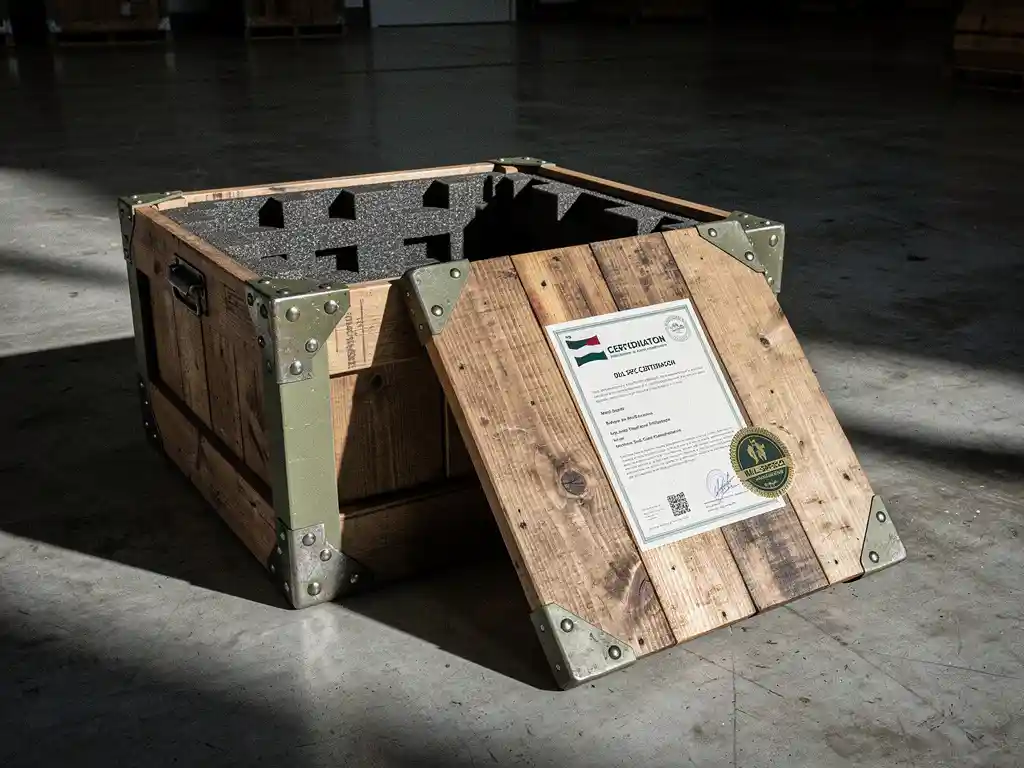
Only a handful of Dutch suppliers are truly skilled in MIL-STD packaging — do you know how to recognize them?
In the Netherlands, only a handful of suppliers are certified or demonstrably competent in MIL-STD packaging. These are specialized companies with proven experience in military specifications — not generic packaging suppliers that occasionally take on defense contracts. In this article, we answer the most frequently asked questions about MIL-STD packaging, so you know exactly what to look for when selecting a supplier.
MIL-STD stands for Military Standard and refers to a series of American defense standards that define the requirements for packaging, storing, and transporting military equipment. MIL-STD-certified packaging provides demonstrable protection against impact, vibration, moisture, pressure changes, and electrostatic discharge — specifically tested and documented in accordance with military protocols.
The most relevant standards for packaging are MIL-STD-648 (packaging requirements), MIL-STD-2073 (standard military packaging procedures), and MIL-STD-810 (environmental testing for military equipment). Each of these standards defines test methods, documentation requirements, and acceptance criteria that packaging must meet before it is declared suitable for military use.
An important distinction: a “MIL-STD-certified supplier” is not the same as a supplier with a single quality mark on the wall. It refers to a demonstrable capability to design, manufacture, and document packaging that complies with the specific MIL-STD standard prescribed in the contract. Which standard applies depends on the nature of the equipment, the transport route, and the operational conditions.
A supplier delivering MIL-STD packaging must meet a range of technical, documentary, and process-related requirements. The core principle is that every package must be traceable, testable, and reproducible, with complete documentation of materials, construction methods, and tests performed.
In practice, a MIL-STD supplier is generally required to have:
Suppliers that only produce standard flight cases or transport crates without these underlying capabilities are technically not qualified for genuine MIL-STD contracts — even if they deliver robust products.
The number of Dutch suppliers that demonstrably comply with MIL-STD packaging standards is limited — estimated at a handful of specialized companies. This is due to the high barrier to entry: the combination of technical expertise, testing capacity, documentation management, and knowledge of military regulations requires years of building competencies and infrastructure.
The Dutch defense industry is relatively small but technically advanced. Suppliers active in this segment have typically been working for years as subcontractors for the Defense Materiel Organization (DMO), NATO programs, or international defense contractors. They are not always visible through ordinary web searches, but are well known to procurement officers through qualification lists and framework contracts.
What further limits the market is that MIL-STD packaging is often part of a broader defense contract in which the packaging supplier acts as a subcontractor. Independent MIL-STD packaging suppliers operating on a fully standalone basis are rarer than those offering this capability as part of a broader service portfolio.
You verify a supplier’s genuine compliance with MIL-STD standards by requesting three things: evidence of previous defense contracts with comparable specifications, relevant test reports or declarations of conformity, and a description of their quality assurance and documentation process. Marketing copy says little; concrete documentation says everything.
A practical checklist for evaluating a potential supplier:
A supplier that struggles with these questions or remains vague in their answers most likely does not have the in-depth MIL-STD experience they claim.
MIL-STD, UN, and NEN are three separate standards frameworks, each with its own scope of application. MIL-STD is a military standard for defense materiel, UN standards apply to the transport of hazardous materials across all modes of transport, and NEN standards are Dutch national standards broadly applicable in industry and trade. They sometimes overlap, but are not interchangeable.
MIL-STD standards were developed by the U.S. Department of Defense and focus on protecting military equipment under extreme operational conditions. The emphasis is on shock, vibration, temperature fluctuations, moisture, and electrostatic discharge. MIL-STD is mandatory when a defense contract specifically requires it and does not apply to civilian transport.
UN markings are mandatory for the transport of hazardous materials such as chemicals, explosives, or radioactive material. They are issued following physical testing by accredited testing institutes and are internationally recognized through agreements such as ADR (road transport), IMDG (sea transport), and IATA (air transport). UN-certified packaging is not automatically suitable for military applications, and vice versa.
NEN standards are managed by the Royal Netherlands Standardization Institute and cover a broad spectrum of industrial requirements, including packaging. They are widely used in civilian industry, healthcare, and government procurement. Some defense contracts in the Netherlands also reference NEN standards, but these are separate from the MIL-STD framework.
MIL-STD packaging is mandatory when a defense contract or order specification explicitly requires it. This is typically the case for contracts from the U.S. Department of Defense, NATO programs with U.S. involvement, or Dutch defense contracts where the equipment must be interoperable with NATO partners that apply MIL-STD.
In practice, MIL-STD packaging is particularly required in the following situations:
For purely Dutch defense contracts without an international NATO component, the Ministry of Defense may also opt for NEN standards or its own specifications. It is always the order specification or Statement of Work (SOW) that determines which standard applies. If in doubt, always explicitly confirm which standard the contracting authority uses before selecting a supplier.
Faes is one of the few Dutch packaging specialists with demonstrable expertise in MIL-STD, UN, and NEN standards. As a full-service packaging partner for the defense sector, Faes offers a complete end-to-end approach — from technical analysis and engineering through to production and documentation.
What Faes specifically delivers for defense clients:
With more than 35 years of experience in custom industrial packaging and a proven track record in regulated sectors, Faes is the partner defense clients need when standards are strict and there is no margin for error. View the full range for the defense sector at Faes defense packaging or get in touch directly for a technical discussion about your specific packaging requirements.


Robert Verboven is Sales Manager at Faes and advises customers on smart packaging solutions within the industry. He translates complex packaging needs into practical solutions that contribute to a more efficient supply chain.
More articles by Robert VerbovenGood packaging doesn’t happen by chance. Using a proven process, our specialists guide you step by step from the initial idea to the final product.