


Theme:
How does military packaging differ for the army versus the navy?
Army or navy? Discover how environmental risks, MIL-STD standards, and material selection determine military packaging requirements for each branch of the armed forces.
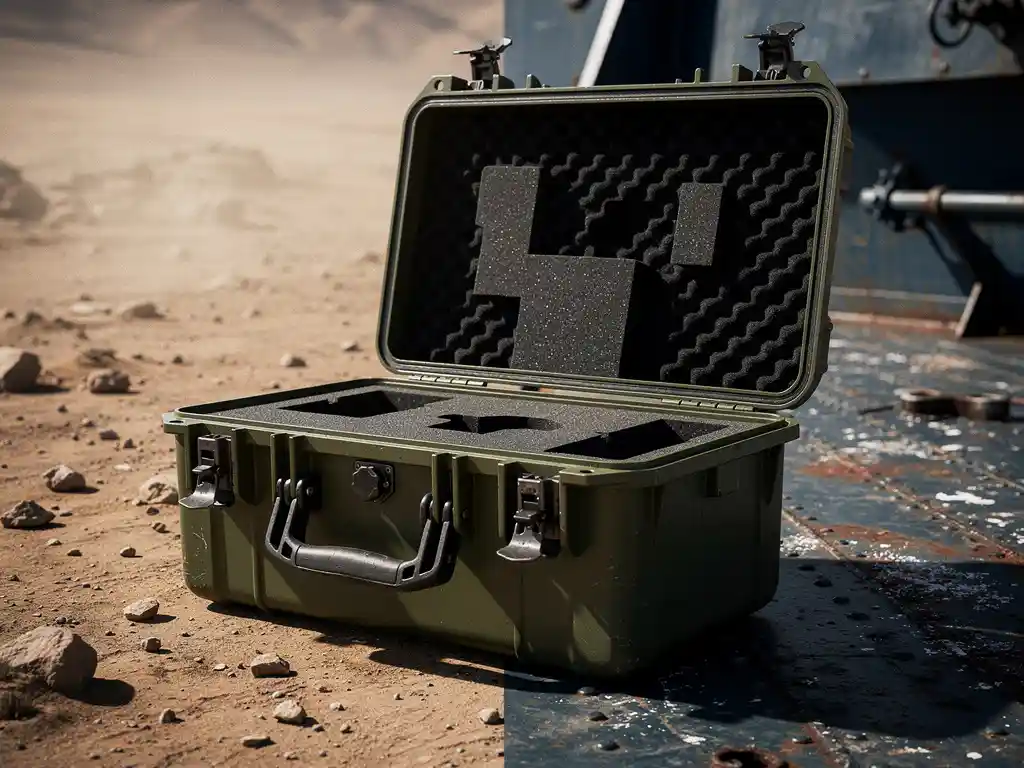
Army or navy? Discover how environmental risks, MIL-STD standards, and material selection determine military packaging requirements for each branch of the armed forces.
Military packaging for the army differs fundamentally from that for the navy, primarily due to the environmental risks that equipment is exposed to. Army equipment must withstand dust, impacts, and extreme temperature fluctuations, while naval equipment also requires protection against salt air, humidity, and corrosion. The specific operational context determines which standards, materials, and construction methods are required. In this article, we answer the most frequently asked questions about the differences in military packaging across branches of the armed forces.
The environmental risks specific to each branch of the armed forces are the primary driver of packaging requirements, because each domain — land, sea, or air — involves fundamentally different physical and climatic conditions. Army packaging must be shock-resistant, dust-proof, and capable of withstanding temperature extremes. Naval packaging must also be corrosion-resistant due to constant exposure to salt water and high humidity.
For the army, the greatest risks are mechanical impacts from rough terrain transport, vehicle vibrations, and exposure to fine dust and sand. Equipment may be carried in armored vehicles, on truck flatbeds, or transported by soldiers on foot. The packaging must handle all of these scenarios without damage to the contents.
For the navy, additional maritime risks come into play. Salt sea air attacks metal components and electronics. Condensation caused by temperature differences between above and below deck creates moisture problems. Packaging is exposed to wave impacts, ship vibrations, and sometimes direct spray water contact. This requires packaging with higher IP ratings, corrosion-resistant closures, and moisture-absorbing elements in the interior.
Air force units and special forces operating across multiple domains place yet another set of demands on packaging: lightweight construction for air transport, but with the same robustness as ground-based transport. This makes environmental analysis the essential first step in designing any military packaging solution.
For army equipment, MIL-STD-810 (environmental testing) and MIL-STD-648 (packaging requirements) are the most widely used standards. For naval equipment, MIL-S-901 for shock resistance and MIL-DTL-24231 for seawater resistance also apply. Both branches fall under the broader MIL-STD-2073 framework for military packaging and preservation, but the test parameters differ significantly.
MIL-STD-810 defines test methods for a wide range of environmental conditions: vibration, shock, extreme temperatures, dust, and altitude. For army applications, the test categories for mechanical shock and dust penetration are the most relevant. Packaging that meets MIL-STD-810G or the more recent MIL-STD-810H has been tested against the conditions associated with ground operations, from desert heat to arctic cold.
Naval equipment is subject to additional requirements in the areas of corrosion resistance and watertightness. MIL-S-901 specifically tests for shock resistance against underwater explosions — a risk that does not apply to land operations. Packaging for ship-based equipment must also comply with STANAG standards harmonized within NATO, ensuring seamless exchange of equipment between allied forces. For Dutch defense organizations, NEN standards are also relevant, particularly where national procurement requirements specify certain certifications.
Electronics and communications systems in the navy require additional protection against moisture and corrosion on top of the standard shock and vibration protection that is central to army packaging. In practice, this means naval packaging carries higher IP ratings, more frequently incorporates desiccants and pressure-compensating valves, and uses corrosion-resistant aluminum or composite materials rather than standard steel.
For the army, the emphasis is on absorbing mechanical energy. Polyethylene or polyurethane foam interiors are custom-cut to encase sensitive components and dampen shocks. Communications systems carried in the field require compact, lightweight packaging that can be opened quickly and withstands rough handling by soldiers.
For naval communications systems, electromagnetic shielding (EMC) is an additional consideration. Ships operate numerous electronic systems simultaneously, which can interfere with one another. Packaging with a Faraday cage construction or conductive foam protects sensitive equipment from electromagnetic interference. This is less critical in ground operations, but is a firm requirement on naval vessels and in electronic warfare applications.
Another difference is the availability of repair facilities. In the field, army packaging must be quick to open and close, even under pressure. On a naval vessel, there is more scope for complex closure systems, but the packaging must withstand prolonged exposure to a humid environment — sometimes for weeks or months at a time.
Reusable military packaging in the field must withstand multiple transport cycles without loss of quality, be easy to inspect and repair, and meet the logistical demands of the operational context. For both army and naval applications, a reusable package only delivers value if it remains structurally intact after repeated use under operational conditions.
For the army, this means crates and cases must withstand loading and unloading from vehicles, stacking in storage facilities, and transport over unpaved roads. Hinges, closures, and corner protectors are the most vulnerable components and must be easy to replace. Modular designs with individually replaceable parts significantly extend service life.
For the navy, storage space is a major consideration. Ships have limited room, so reusable packaging must be stackable and occupy as compact a volume as possible. At the same time, it must withstand the humid environment of a ship’s hold. Packaging with an integrated moisture indicator shows when the contents are at risk, enabling preventive maintenance.
From a sustainability perspective, reusable military packaging offers a clear advantage: less waste, lower total lifecycle costs, and reduced logistical pressure on return flows. Defense organizations that invest in high-quality reusable packaging see a lower total cost of ownership over the long term compared to single-use solutions.
Drones and unmanned systems require packaging that protects fragile components such as rotor blades, sensors, and batteries while also enabling rapid deployment in the field. For land missions, the focus is on shock absorption and dust protection. For sea missions, watertightness and corrosion resistance are added requirements, as naval platforms deploy drones from a wet, salt-laden environment.
Army drone packaging is often designed for rapid deployment: fold-out foam compartments that allow a drone to be made operational in a short time. The packaging serves simultaneously as a protective case during transport and as a workstation for basic field maintenance. Weight is a critical factor, as drones are frequently carried by small teams.
For naval applications, drones are sometimes larger systems deployed for reconnaissance or mine detection. The packaging must withstand the harsh conditions of a ship at sea: engine vibrations, humid air, and the risk of spray water. These packages are often constructed from seawater-resistant aluminum with silicone seals and pressure-compensating valves to prevent condensation damage.
A specific consideration for drones is the packaging of lithium batteries. These fall under UN transport regulations (UN 3480/3481) and require specialized packaging capable of managing thermal runaway. For both land and sea missions, batteries are packaged separately in flame-retardant pouches or insulated compartments, in compliance with both military and civilian transport regulations.
A custom packaging solution is necessary when standard military cases cannot accommodate the specific dimensions, weight distribution, or protection requirements of the equipment. This is the case for unique or advanced systems, combinations of components that must travel together, or situations where operational efficiency depends on a specific packaging layout.
Standard military cases are designed for general use and meet basic standards. They are cost-effective for generic equipment, but fall short when dealing with irregularly shaped items, fragile protrusions, or specific orientation requirements during transport. A communications system with antennas, a drone with fixed rotor blades, or medical equipment with breakable components requires an interior that is precisely custom-cut.
Custom solutions are also necessary when the packaging serves an operational function beyond pure protection. Examples include packaging that doubles as a workstation, features built-in charging capabilities for batteries, or incorporates quick-release systems for rapid deployment. These functional requirements cannot be met with a standard case.
Finally, logistical considerations play a role. When equipment is regularly transported by aircraft, helicopter, or ship, the weight and dimensions of the packaging can directly affect operational capacity. A custom solution can minimize total volume, optimize stackability, and reduce weight through the use of lightweight composite materials — without compromising protection.
Faes.nl develops and manufactures military packaging fully tailored to the requirements of your branch of the armed forces, whether that is the army, the navy, or a combined operational context. With more than 35 years of experience in industrial custom packaging and in-depth knowledge of MIL-STAN, UN, and NEN standards, Faes delivers end-to-end solutions that meet the highest military quality requirements.
What Faes specifically offers defense customers:
Faes combines traditional Dutch craftsmanship with innovative, sustainable packaging processes. As a specialist in regulated sectors, Faes understands the critical requirements that defense organizations demand, and delivers solutions that make a real difference both operationally and logistically. Want to find out what Faes can do for your defense packaging challenge? Explore Faes’s defense packaging solutions and get in touch for a no-obligation consultation.


Robert Verboven is Sales Manager at Faes and advises customers on smart packaging solutions within the industry. He translates complex packaging needs into practical solutions that contribute to a more efficient supply chain.
More articles by Robert VerbovenGood packaging doesn’t happen by chance. Using a proven process, our specialists guide you step by step from the initial idea to the final product.