


Theme:
What NATO packaging requirements apply to the transport of military equipment?
STANAG, MIL-STD, Level A through C: discover which NATO packaging requirements apply to military equipment and drones.
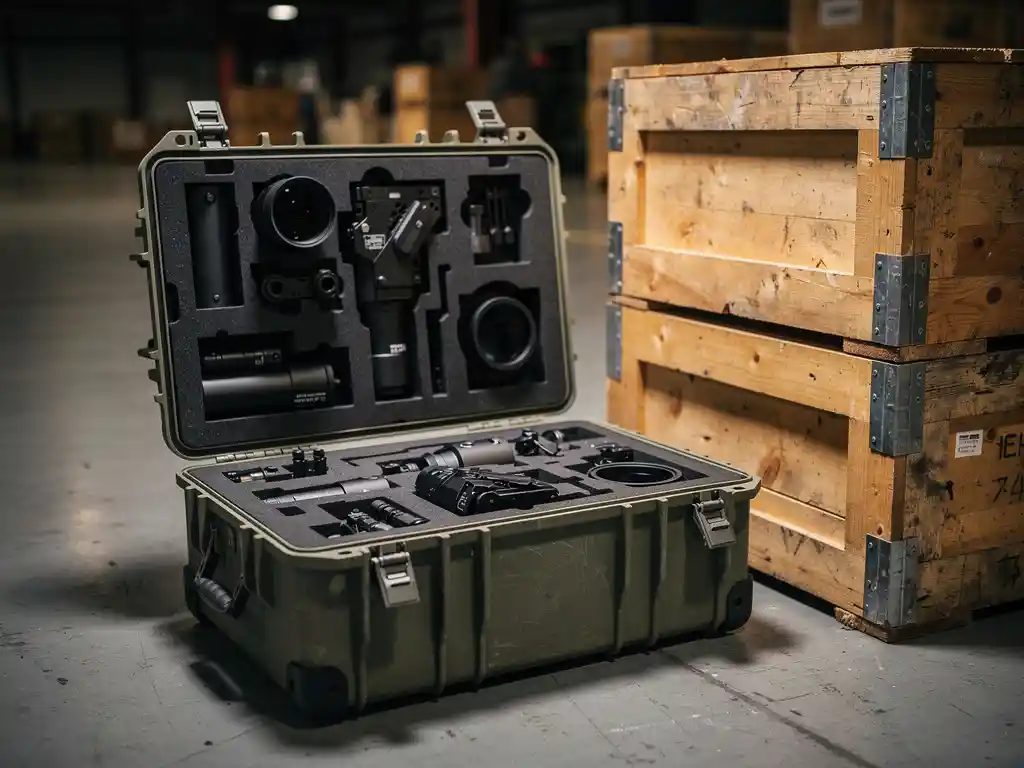
STANAG, MIL-STD, Level A through C: discover which NATO packaging requirements apply to military equipment and drones.
The transport of military equipment is governed by NATO packaging requirements primarily set out in NATO STANAG standards (Standardization Agreements), supplemented by national MIL-SPEC standards such as the American MIL-STD-2073. These standards define how military goods are packaged, marked, documented, and protected against mechanical, climatic, and electrostatic damage. The requirements apply to all member states and cover both civilian contractors and defense organizations that supply or transport equipment for military purposes. In this article, we answer the most frequently asked questions about military packaging standards, protection levels, permitted materials, and transport-specific requirements.
NATO packaging requirements are based on a combination of STANAG standards, national military specifications, and international transport regulations. The primary standard is STANAG 4280, which establishes the general requirements for military packaging and marking for use across NATO member states. In addition, the American MIL-STD-2073 serves as a widely used reference for packaging processes and protection levels in defense contracts.
Beyond these core documents, the following standards also play a role:
For Dutch defense contractors, NEN standards also apply as a supplementary framework, particularly regarding safety requirements and material qualifications. It is important to understand that NATO standards function in practice as minimum requirements. Individual member states or contracting authorities may impose additional requirements depending on the nature of the equipment, the destination, and the operational context.
NATO standards define three protection levels for military packaging, designated as Level A, Level B, and Level C. Each level corresponds to a specific degree of protection and is intended for different storage and transport conditions. The choice of level depends on the sensitivity of the materiel, the expected environmental conditions, and the duration of storage or transport.
Level A provides the highest degree of protection and is intended for equipment exposed to extreme conditions, such as high humidity, temperature fluctuations, saltwater, or long-term storage. This level requires hermetically sealed packaging with desiccants, humidity indicators, and barrier materials meeting MIL-PRF-131 or equivalent specifications. It is applied to critical electronic systems, precision instruments, and mission-critical components.
Level B provides protection against normal transport conditions and short-term exposure to moisture and dust. Packaging at this level uses waterproof bags or sealable containers without a fully hermetic seal. This level is suitable for equipment that will be placed into service relatively soon after packaging, or that is less sensitive to moisture.
Level C is the basic form of military packaging and provides protection against mechanical damage during normal transport. It does not require special barrier materials, but does require adequate shock absorption and a sturdy outer package. This level is applied to robust materiel that is not sensitive to climatic influences.
Under military specifications, permitted packaging materials must meet established qualifications for strength, barrier performance, chemical inertness, and durability. Material selection is determined by the required protection level, the nature of the contents, and the transport conditions. Non-qualified or untested materials are generally rejected in defense contracts.
Commonly permitted materials include:
Materials containing halogen compounds or those that release toxic substances when burned are increasingly being excluded, partly on sustainability grounds. Reusable packaging made from aluminum or high-grade plastics also aligns well with circular packaging principles without compromising protective performance.
Drones and electronic systems fall under the most stringent NATO packaging requirements due to their sensitivity to shock, vibration, moisture, and electrostatic discharge. Packaging must provide at least Level A protection and must always incorporate ESD-safe materials. Custom foam interiors are standard practice to hold fragile components in their exact positions and eliminate movement during transport.
For drones, the following considerations apply specifically:
MIL-STD-810 is a key reference in this context: this American military test standard describes the environmental stresses that packaging and its contents must be able to withstand, including free-fall drop tests, vibration profiles, and temperature cycling. Packaging for drones should ideally be tested or designed in accordance with these profiles.
Military packaging must carry standardized markings and accompanying documentation that enable the identification, traceability, and safe handling of the cargo. STANAG 2827 and MIL-STD-129 specify what information must appear on the packaging and in what format. Missing or incorrect markings can result in delays, rejection, or hazardous situations upon receipt.
Required elements on the packaging typically include:
The accompanying documentation must include at minimum a packing list with a detailed description of the contents, the protection level applied, and the materials used. For dangerous goods or lithium batteries, additional transport documents are required. For NATO deliveries, a DD Form 250 (Material Inspection and Receiving Report) or an equivalent national document is also required.
UN certification is required alongside NATO standards whenever the cargo contains dangerous goods subject to international regulations for the transport of hazardous materials. This applies regardless of the military classification of the shipment. UN regulations apply via ADR (road transport), RID (rail transport), IMDG (sea transport), and IATA DGR (air transport), and are independent of military packaging standards.
Situations in which UN certification is required in addition to NATO packaging requirements:
In practice, this means that packaging for a drone containing lithium batteries must comply with both NATO standards (for military protection) and UN 38.3 (for the batteries). Both sets of requirements are cumulative: compliance with one does not exempt from the other. A capable packaging partner understands this interplay and ensures that the packaging satisfies both frameworks simultaneously.
Packaging for air transport imposes stricter requirements on weight, pressure resistance, and safety classification than land or sea transport. IATA DGR regulations govern dangerous goods in air transport and are more stringent than ADR or IMDG. In addition, weight and dimensions are more critical in air transport due to cargo space limitations and higher transport costs per kilogram.
In air transport, packaging must withstand pressure differentials in the cargo hold, which has implications for packages containing sealed air spaces or pressure-sensitive contents. Aluminum flight cases and plastic transport cases are popular due to their low weight and high strength-to-weight ratio. Dangerous goods are subject to the strictest restrictions in air transport: some substances that may be transported by road are entirely prohibited by air.
Sea transport demands maximum protection against moisture, salt, and mold. Level A packaging with hermetic sealing, desiccants, and corrosion-inhibiting treatment is standard. Wooden crates must be ISPM-15 certified for international shipment. The longer transit times associated with sea transport also mean that packaging must maintain its protective properties over extended periods.
During land transport, particularly over unpaved roads or in tactical military vehicles, shock and vibration pose the greatest threat. Packaging must be designed with comprehensive shock absorption and vibration damping. MIL-STD-810 test profiles for vehicle transport serve as the reference here. Weight is less of a decisive factor in land transport than in air transport, allowing for heavier protective constructions.
Faes develops and manufactures custom packaging solutions that fully comply with NATO packaging requirements and related military standards. With more than 35 years of experience in industrial custom packaging and in-depth knowledge of MIL-SPEC, UN, and NEN standards, Faes guides defense clients from engineering through to delivery. Everything is designed, produced, and tested in-house, giving defense contractors and military organizations full confidence that their packaging meets all applicable requirements.
What Faes delivers specifically for defense applications:
Faes works with Dutch and international defense organizations, military technology suppliers, and drone developers that need to protect mission-critical equipment. The combination of technical expertise, knowledge of regulated sectors, and a sustainable approach makes Faes a reliable partner for complex defense packaging challenges. Want to find out how Faes can solve your specific packaging requirements? Explore Faes defense packaging solutions or get in touch directly for a no-obligation consultation.


Robert Verboven is Sales Manager at Faes and advises customers on smart packaging solutions within the industry. He translates complex packaging needs into practical solutions that contribute to a more efficient supply chain.
More articles by Robert VerbovenGood packaging doesn’t happen by chance. Using a proven process, our specialists guide you step by step from the initial idea to the final product.