


Theme:
When does TCO logistics optimization have the greatest impact?
Hidden logistics costs are eating into your margin — find out when TCO optimization makes the biggest impact.
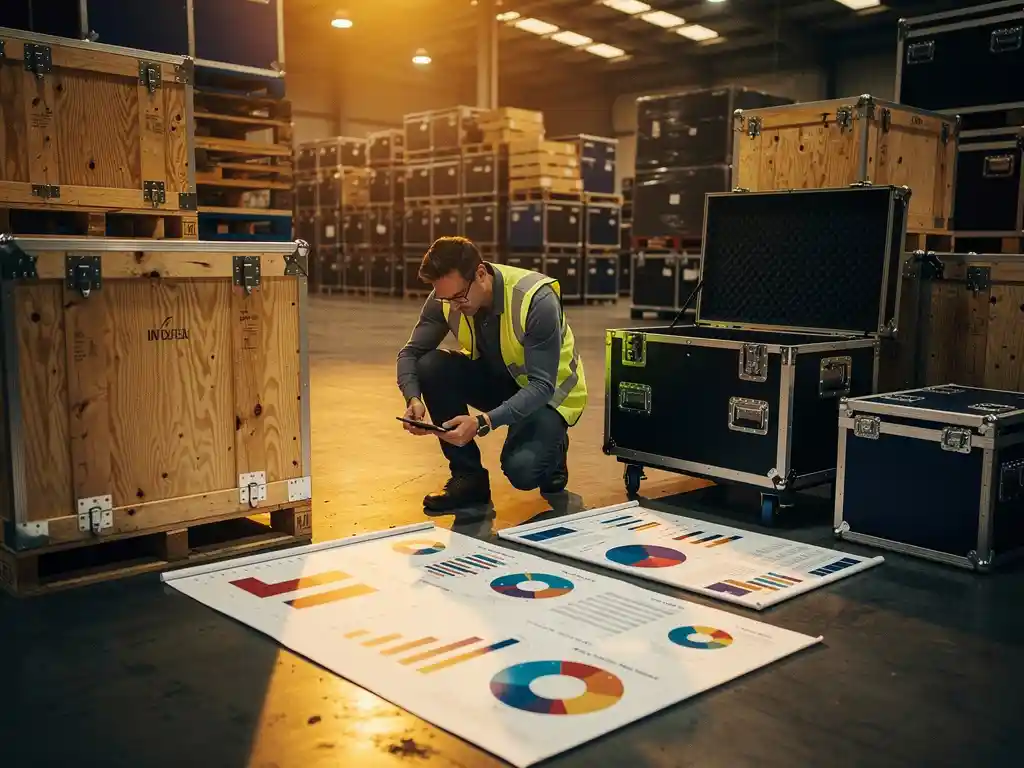
Hidden logistics costs are eating into your margin — find out when TCO optimization makes the biggest impact.
TCO logistics optimization has the greatest impact when packaging processes are structurally generating costs that are not visible in the purchase price. That is precisely where traditional cost calculation falls short: you see the invoice, but not the damage. For companies in the high-tech, medical, and defense sectors — where products are expensive and fragile — the difference between a low purchase price and a low total cost can be enormous. In this article, we answer the most frequently asked questions about TCO in logistics, from hidden costs to knowing the right moment to take action.
Hidden costs in logistics processes are all expenses that do not appear directly on the purchase invoice, yet genuinely affect the bottom line. Think of damage during transport, unnecessary storage space, inefficient return flows, labor-intensive packaging operations, and lost production time caused by packaging that does not fit properly. These costs are difficult to spot, but they add up quickly.
In practice, the following hidden cost items occur most frequently:
What makes hidden costs particularly challenging is that they are spread across multiple departments — purchasing, logistics, production, and quality. As a result, no single department is directly held accountable for them, and they consistently fly under the radar.
Traditional cost calculation in logistics looks at the direct purchase price of a packaging solution. TCO, or Total Cost of Ownership, considers all costs associated with a packaging solution throughout its entire lifecycle. The difference lies not in the formula but in the scope: TCO makes visible the costs that would otherwise remain out of sight.
With traditional cost calculation, you compare two quotes on a per-unit price basis. A cheaper package then appears to be the logical choice. But if that packaging offers less protection, requires more handling, cannot be returned, and needs to be replaced more frequently, its actual total cost is higher than that of the more expensive option — which carries none of those drawbacks.
TCO in logistics typically covers the following categories:
The key advantage of TCO is that it enables a fair comparison. Two solutions that are close in purchase price can differ by tens of percentage points in TCO. That makes TCO a strategic tool, not just a financial calculation.
TCO analysis delivers the greatest savings in sectors where products have high value, are vulnerable to damage, or are subject to strict regulation. Specifically, these are the high-tech industry, the medical sector, defense, and security services. In these sectors, the consequences of a poor packaging choice are not only financial but also operational and legal.
Companies that manufacture and transport precision instruments or electronic components deal with products where even minor vibrations or electrostatic discharge can cause damage. A TCO analysis reveals the true cost of a damaged shipment, including replacement, production downtime, and customer loss. Reusable, custom-made packaging with foam interiors and antistatic protection is almost always more cost-effective on a TCO basis than single-use alternatives.
The medical sector imposes strict requirements regarding hygiene, traceability, and protection. Packaging that does not meet applicable standards can result in rejected shipments, product recalls, or delays in critical supply chains. The TCO of a compliant packaging solution is almost always lower than the cumulative cost of incidents associated with non-compliant alternatives.
Defense organizations work with equipment that must withstand extreme conditions: shocks, vibrations, moisture, extreme temperatures, and chemical exposure. Here, MIL-STAN standards are the governing framework. A TCO-based approach demonstrates that investing in certified, durable packaging across multiple missions is considerably more cost-effective than repeatedly procuring new single-use packaging.
You calculate the TCO of a packaging solution by mapping all costs associated with using that packaging throughout its full lifecycle. This starts with the purchase price but does not end until the packaging is disposed of or reaches the end of its use cycle. A structured four-step approach makes this manageable.
Step 1: Map the lifecycle. Determine how long a packaging solution lasts, how often it is used, and what operations are required per cycle. A reusable flight case that lasts ten years and is used a hundred times per year has a very different cost profile than a single-use wooden crate.
Step 2: Quantify all cost items. Use the categories from the TCO framework: acquisition, usage, transport, maintenance, returns, disposal, and risk. Assign a concrete amount or a realistic estimate to each category. Involve the departments that work most closely with the packaging, as they are most familiar with the hidden time costs.
Step 3: Compare scenarios. Put at least two packaging scenarios side by side and calculate the TCO per shipment or per year. Note that a higher purchase price can lead to a lower TCO if the packaging requires less maintenance, causes less damage, and generates less waste.
Step 4: Include risks as a cost factor. Damage, non-compliance, and delays are not abstract risks. Assign them a probability percentage and an average cost figure, and include them as expected annual costs. This makes the risk profile of a cheaper solution directly comparable to a more expensive but more reliable alternative.
The right time for TCO optimization is when your logistics costs are rising without a corresponding increase in volumes, when you are experiencing recurring damage or complaints, or when you are scaling your packaging processes to new markets or higher volumes. A change in regulations or sustainability targets is also a direct trigger.
Concrete signs that TCO optimization is timely:
TCO optimization is not a one-time project but an ongoing process. That said, there are moments when the impact is greatest: at contract renewals with logistics partners, when redesigning products or processes, and during significant growth in shipping volumes. At those moments, decisions are already on the table, and adding a TCO perspective requires relatively little additional effort.
To measure TCO in logistics, you need data from multiple sources: purchasing records, warehouse management, transport registrations, damage insurance, and labor records. The quality of your TCO analysis depends entirely on the completeness of this data. If a category is missing, you will underestimate the true costs.
The minimum dataset for a reliable TCO calculation consists of:
In practice, this data is not always centrally available. Damage costs sit with the insurance department, labor costs with HR, and transport costs with purchasing. A first step is therefore to consolidate these data streams into a single overview. Digital tools that monitor packaging processes — such as inventory management and return logistics systems — make this considerably easier.
Faes helps companies in the high-tech, medical, and defense sectors gain insight into and reduce the total costs of their packaging processes. This does not begin with a standard solution, but with a thorough analysis of your specific logistics chain. Faes combines technical expertise, digital tools, and years of sector knowledge to design packaging that demonstrably outperforms alternatives on a TCO basis.
Specifically, Faes offers the following elements through Packaging Management that directly contribute to TCO reduction:
Want to know what TCO optimization can mean for your logistics chain? Contact Faes and discover how an integrated approach to your packaging processes leads to structural cost savings, less damage, and a more sustainable supply chain.


Michel Prins is Account Manager at Faes and a specialist in Safety & Security. Thanks to his background at the Ministry of Defense and years of experience in the sector, he advises organizations on reliable packaging solutions for critical applications. He combines practical knowledge with technical expertise to package sensitive equipment safely and efficiently.
More articles by Michel PrinsGood packaging doesn’t just happen by chance. Using a tried-and-tested approach, our specialists guide you step by step from the initial idea to the finished product.