


Theme:
How are military packaging tested for shock and vibration resistance?
How military packaging is tested for shock and vibration — from MIL-STD-810 to field validation.
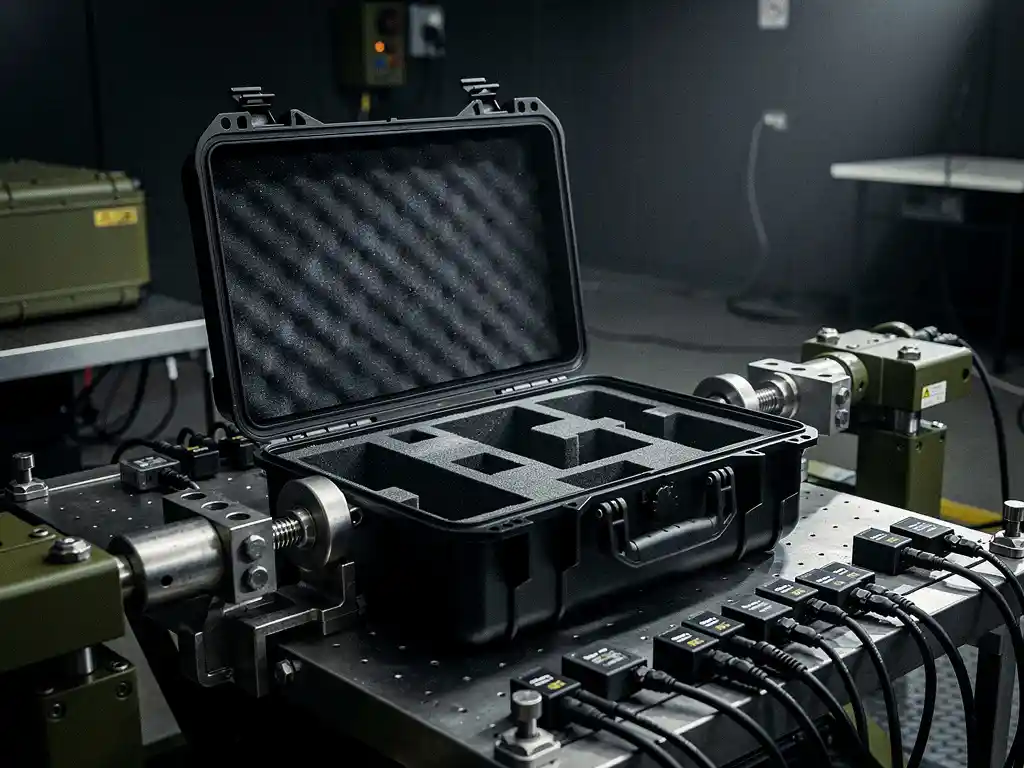
How military packaging is tested for shock and vibration — from MIL-STD-810 to field validation.
Military packaging is tested for shock and vibration resistance through standardized test procedures defined in specifications such as MIL-STD-810 and ISTA. During these tests, the packaging is exposed to simulated transport and deployment conditions, while measurement equipment records how much force actually acts on the contents. The questions below give you a complete picture of how that testing process works, from standards to material behavior.
Test requirements for military packaging are primarily governed by MIL-STD-810, the U.S. military standard for environmental testing, and STANAG standards used within NATO. In addition, ISTA protocols (International Safe Transit Association) and ISO 2247 are relevant for vibration testing.
MIL-STD-810 is the most widely used reference in the defense sector. The standard describes dozens of test methods covering a wide range of environmental factors: shock, vibration, extreme temperatures, humidity, and air pressure. For packaging, Method 514 (vibration) and Method 516 (shock) are particularly decisive. Each method specifies which test conditions are simulated, how long the test runs, and what the acceptance criteria are.
STANAG standards are specifically aimed at interoperability within NATO. They ensure that equipment from different member states follows the same packaging and transport requirements. For sensitive military hardware such as communication systems, drones, and optical equipment, these standards are not optional — they are mandatory. A package that does not meet the applicable standard is simply rejected, regardless of how robust it appears.
It is important to understand that standards are not static. MIL-STD-810 has undergone multiple revisions, with test methods refined based on new insights into real-world transport behavior. Anyone developing military packaging today must work with the most current version of the applicable standard.
A shock test for military transport packaging simulates sudden impacts that occur during drops, emergency stops, or rough handling. The package is placed on a shock pulse generator or drop test machine and exposed to defined peak accelerations, expressed in G-forces, over a specified time period.
The test setup follows a fixed protocol. First, the package is fitted with accelerometers — both on the outside of the package and directly on or near the contents. This allows you to measure not only what the package itself experiences, but also how much shock energy actually reaches the contents. That difference — the so-called transmission ratio — is the core of what you want to know.
In a free-fall test, the package is dropped from a prescribed height onto various surfaces: corners, edges, and faces are all tested. This simulates the type of damage that occurs from careless handling in the logistics chain. The drop height depends on the weight of the package and the hazard classification of the contents.
A shock pulse generator works differently: the package sits on a platform that undergoes a sharp acceleration and deceleration via a controlled impulse. This allows you to simulate specific shock profiles, such as the impact a vehicle experiences when driving over an obstacle or the shock of an emergency landing. The pulse shape — half-sine or trapezoidal — and the peak value are defined in advance in the test protocol.
After each shock test, the package is visually inspected for cracks, deformation, and loosened closures. The contents are then checked for functional damage. A military package passes only if the contents remain fully operational after the complete test series. Cosmetic damage to the exterior of the package is generally accepted, as long as its protective function remains intact.
During a vibration test for military packaging, the acceleration response on the package contents is measured as a function of frequency and time. The key question is: at which frequencies does resonance occur, and how much vibration energy reaches the contents being protected?
Vibration in transport is not a single impact but a continuous process. A truck on an unpaved road, a helicopter in flight, or a ship at sea all produce a broad spectrum of frequencies. Some of those frequencies may coincide with the natural frequency of the package or its contents, causing resonance. At resonance, vibrations are amplified rather than dampened, potentially resulting in serious damage.
The measurement proceeds in two phases. First, a sinusoidal sweep is performed: a frequency range — typically 5 to 500 Hz — is systematically scanned to identify resonance frequencies. This is followed by a broadband random noise test, in which a random vibration pattern representative of the actual transport profile is applied. Accelerometers on the contents continuously record the response.
What you do with that data is at least as important as the measurement itself. A resonance peak at a particular frequency means that the foam interior, the mounting points, or the packaging structure must be adjusted at that point. Well-designed military packaging is engineered so that critical resonance frequencies fall outside the transport spectrum.
Lab simulation reproduces standardized shock and vibration profiles in a controlled environment, while field testing exposes the packaging to actual transport conditions. Both methods are complementary: lab simulation ensures reproducibility and standards compliance, while field testing validates whether laboratory results correspond to real-world conditions.
In the laboratory, you have full control over test parameters. You can repeat exactly the same test, compare results between different packaging designs, and demonstrate that a package meets a specific standard. This is essential for certification and contractual obligations. The limitation is that lab tests can never replicate all the variables of a real transport route — such as the combination of temperature fluctuations, humidity, and mechanical stress over an extended period.
Field testing fills this gap. By instrumenting the package with data loggers and sending it along on an actual transport route, you collect data on the real-world loads it experiences. That data is then used to refine the laboratory test profile or to confirm that the simulated conditions were representative. For defense applications — where equipment can end up in extreme and unpredictable environments — field validation is a valuable complement to lab certification.
A practical drawback of field testing is reproducibility: no two transport routes are ever identical. As a result, field test results are harder to compare and cannot be used as formal certification evidence. They are, however, indispensable for improving designs and identifying weaknesses that did not emerge in the lab.
Under high shock loads, closed-cell polyethylene foam (PE foam), polyurethane (PU) foam, and composite constructions combining aluminum or steel shells with foam interiors perform best. The choice depends on the energy density of the shock, the weight of the contents, and the required protection class.
PE foam is the standard for military applications due to its combination of high energy absorption, chemical resistance, and long service life. The material deforms plastically under shock, meaning it absorbs energy by permanently compressing. This is advantageous for single extreme impacts, but it also means the foam must be replaced after a severe impact. For reusable military packaging, PU foam is therefore often preferred, as it is more elastic and recovers its shape better after repeated loading.
The outer shell of the package plays an equally important role. Aluminum flight case constructions offer an excellent weight-to-stiffness ratio, allowing them to distribute shock energy effectively across the foam interior without concentrating forces at a single point. Steel constructions are heavier but provide greater protection under extremely high impacts, such as those that can occur from blast pressure or vehicle accidents.
For the most demanding applications, layered systems are sometimes used: a hard outer shell, a first layer of rigid foam for coarse energy absorption, and a second layer of soft foam directly surrounding the contents for finer dampening. This principle — cascade dampening — makes it possible to protect effectively across a wide range of shock intensities without making the overall package excessively heavy.
Military packaging must be retested after significant design changes, after repairs to structural components, when the contents change in weight or fragility, or when the applicable standard has been revised. Periodic retesting is also required once the package has completed a prescribed number of transport cycles.
Design changes are the most obvious trigger. Even a minor adjustment to the foam interior, the closures, or the shell construction can significantly affect shock and vibration performance. The general rule is: if you change anything about the package that could affect energy transfer to the contents, retest.
Repairs are a particular area of concern. A repaired package behaves mechanically differently from a new one, because the material structure has been altered by prior loading. For critical military applications, standard practice is to retest after a significant repair, even if the package appears visually intact.
Standard revisions are a less visible but equally important trigger. When MIL-STD-810 or a relevant STANAG standard is updated, a previously certified package may no longer meet the new requirements. Defense contractors are responsible for tracking standard changes and initiating retesting in a timely manner. This is a current concern, as several military standards have recently been revised in response to new insights into modern transport modes and threat scenarios.
Faes develops and manufactures military packaging for defense designed to comply with MIL-STD-810, STANAG, and other relevant standards. This process begins not at production, but at the design stage: by accounting for test criteria during the engineering phase, packaging is built to pass on the first test run rather than after multiple iterations.
What Faes offers defense customers in concrete terms:
With more than 35 years of experience in custom industrial packaging and a specialization in regulated sectors, Faes understands what is at stake when mission-critical equipment is in transit. Want to know which packaging solution fits your defense application and which standards apply? Contact Faes for a no-obligation consultation with one of our packaging specialists.


Robert Verboven is Sales Manager at Faes and advises customers on smart packaging solutions within the industry. He translates complex packaging needs into practical solutions that contribute to a more efficient supply chain.
More articles by Robert VerbovenGood packaging doesn’t happen by chance. Using a proven process, our specialists guide you step by step from the initial idea to the final product.