


Theme:
How do you factor return logistics into a TCO logistics calculation?
Hidden return costs structurally undermine your TCO — find out how to factor them in correctly.
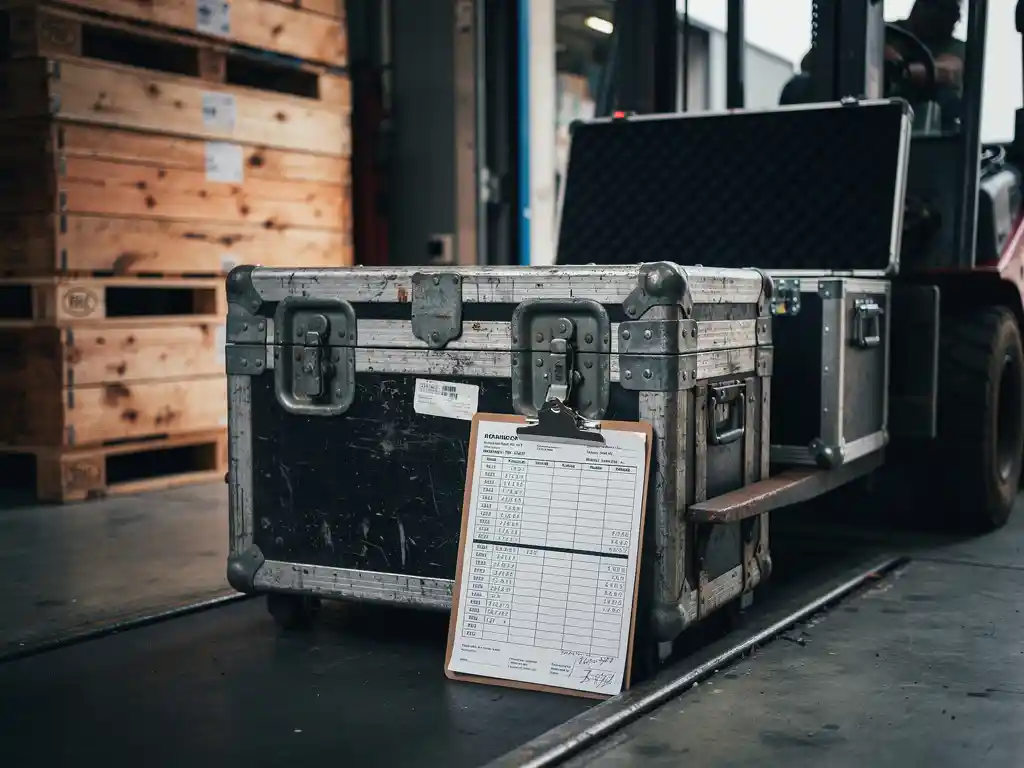
Hidden return costs structurally undermine your TCO — find out how to factor them in correctly.
To include return logistics in a TCO logistics calculation, you need to explicitly account for all costs associated with the reverse flow of packaging: return transport, inspection, cleaning, repair, storage, and any depreciation. Without these cost components, you will systematically underestimate the true costs of your packaging strategy. In this article, we answer the most frequently asked questions about a complete TCO calculation for logistics, including return flows and reusable packaging.
A standard TCO logistics calculation typically focuses on the purchase price of packaging, direct transport costs, and basic storage. Costs that arise further down the chain — such as return logistics, maintenance, quality control, and packaging failure — are left out of the equation. This makes the calculation incomplete and leads to poor decisions about packaging strategy.
The most commonly overlooked cost components are:
For sectors such as high-tech, medical, and defense, these hidden costs are particularly significant. Packaging for sensitive equipment or regulated products must meet strict standards at every cycle. A damaged flight case or a foam interior that no longer fits correctly can result in product damage with serious financial consequences. Looking only at the purchase price of packaging means missing the complete picture.
You calculate the true costs of return logistics by mapping all direct and indirect costs per return cycle and multiplying them by the expected number of cycles per year. Add together: return transport costs, handling costs, inspection time, cleaning or repair costs, and storage costs per cycle.
A practical approach works in steps:
A common mistake is underestimating the handling costs on the recipient’s side. For international shipments to customers in the high-tech or medical sector, the receiving party often needs to inspect, register, and prepare the packaging for return. Those labor hours do not appear on the freight invoice, but they are very much part of the total logistics costs.
It is also wise to build in a buffer for packaging that is lost or so damaged it can no longer be used. In practice, an attrition rate of five to ten percent per year is realistic for heavily used industrial packaging, depending on the sector and conditions.
In a TCO logistics calculation, the cost structure of single-use and reusable packaging differs fundamentally. Single-use packaging has low upfront costs but generates new costs with every shipment. Reusable packaging has higher acquisition costs, but the cost per cycle decreases the more frequently it is used.
With single-use packaging, the costs per shipment are relatively transparent: purchase price, filling material, labor for packing, and disposal of the packaging materials after receipt. There is no return flow for the packaging itself, which simplifies logistics. However, hidden costs do exist: waste disposal at the recipient’s end, higher purchasing volumes during fluctuating demand, and the risk that standard single-use packaging provides insufficient protection for expensive or sensitive products.
Reusable packaging such as flight cases, custom racks, or industrial crates carries a higher purchase price, but that investment is spread across dozens or hundreds of cycles. The TCO per shipment therefore decreases the more frequently the packaging is used. Set against this are the return logistics costs that do not apply to single-use packaging: return transport, storage, inspection, and maintenance.
The breakeven point in the calculation lies at the number of cycles. Organizations that ship infrequently and irregularly benefit less from reusable packaging. Those that consistently ship large volumes to fixed destinations will find that the TCO of reusable packaging becomes significantly lower over time than that of single-use alternatives. In addition, reusable packaging offers better protection, which reduces the risk of product damage and thereby also the hidden costs of packaging failure.
The payback period for reusable packaging is determined by the ratio between the premium over single-use alternatives and the savings per cycle. The greater the difference in cost per cycle and the higher the shipping volume, the faster the investment pays for itself.
The key factors are:
In practice, companies in the high-tech and defense sectors often see a payback period of two to four years for custom reusable packaging, depending on volume and the complexity of the return flow. For standard industrial packaging with a high turnover rate, this can be shorter.
For international shipments, you incorporate return flows into the TCO logistics calculation by accounting for customs formalities, longer transport times, higher return freight rates, and any local storage costs. Complexity increases as more countries are involved, which significantly raises the total return costs per cycle.
Specific considerations for international return flows include:
A practical solution for international return flows is to work with a fixed pool size per region. Rather than sending every piece of packaging back to the point of origin, you maintain a buffer at frequently used destinations. This reduces transport costs and increases availability, but does require solid inventory management and a system to track the location of every piece of packaging.
A complete TCO logistics analysis is built using a combination of cost price models, lifecycle analyses, and digital tracking tools. The most effective approach combines a structured calculation model with real-time data on usage, return flows, and packaging status.
Proven methods and tools include:
Beyond the tools themselves, the quality of the input data determines the reliability of the analysis. Many organizations lack detailed data on handling costs, attrition rates, or return freight rates. It is advisable to start with a pilot on a specific product group or destination, so that you gather realistic cost data before scaling the analysis to your full logistics operation.
Faes offers a concrete solution for organizations that want to structurally incorporate return logistics into their TCO logistics calculation. As a full-service packaging partner, Faes takes responsibility not only for packaging development, but also for the complete management of the packaging chain, including return flows.
What Faes delivers in practice through Packaging Management:
Faes works with clients in high-tech, medical, defense, and security who want to understand and reduce their packaging costs without compromising on protection or compliance. By treating return logistics as an integral part of the packaging strategy — rather than an afterthought — Faes helps you gain clear insight into the true TCO and improve it structurally. Want to know what a complete TCO analysis could mean for your situation? Contact Faes for a no-obligation consultation.


Michel Prins is Account Manager at Faes and a specialist in Safety & Security. Thanks to his background at the Ministry of Defense and years of experience in the sector, he advises organizations on reliable packaging solutions for critical applications. He combines practical knowledge with technical expertise to package sensitive equipment safely and efficiently.
More articles by Michel PrinsGood packaging doesn’t just happen by chance. Using a tried-and-tested approach, our specialists guide you step by step from the initial idea to the finished product.